Los Angeles Department of Water and Power (LADWP) supply mains frequently push dynamic water pressures between 90 and 140 PSI through valley distribution networks and gravity-fed hillside runs. Section 608.2 of the Los…
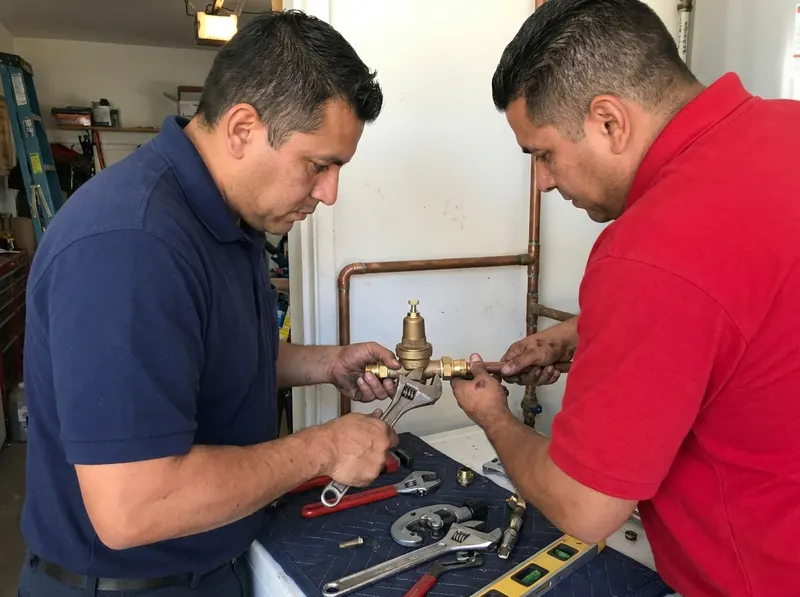
Los Angeles Department of Water and Power (LADWP) supply mains frequently push dynamic water pressures between 90 and 140 PSI through valley distribution networks and gravity-fed hillside runs. Section 608.2 of the Los Angeles Plumbing Code mandates that incoming domestic water supply exceeding 80 PSI must be managed by an approved pressure-reducing device. High pressure ruptures washing machine hoses, causes continuous toilet fill-valve leaks, triggers water hammer banging inside wall framing, and voids manufacturer warranties on tankless water heaters. A calibrated pressure-reducing valve (PRV) acts as an automatic hydraulic buffer: street pressure pushes against an internal spring-loaded diaphragm, restricting the internal orifice to maintain a downstream pressure of roughly 55 PSI regardless of fluctuating street pressure surges from hillside pumping stations.
Installing a PRV differs substantially depending on municipal pipe depth and meter proximity. In flat terrain neighborhoods like Koreatown, Boyle Heights, and Venice, the city water meter box sits near the sidewalk, but the primary regulator installs directly at the residential shutoff point where the line emerges above grade. If incoming pressure measures below 75 PSI at the exterior hose bibb, a PRV is technically unnecessary unless local municipal line fluctuations cause periodic valve chattering; conversely, if static pressure exceeds 80 PSI, valve installation is non-negotiable to prevent plumbing fixtures from sustained mechanical wear. The mechanical trade-off involves water volume versus force: reducing pressure protects supply lines and fixtures, but undersized regulators (such as fitting a 3/4-inch valve onto an active 1-inch main line) restrict peak gallons-per-minute flow when multiple showers run simultaneously.
Micro-neighborhood topography determines line strain. Steep elevations surrounding Elysian Park, Silver Lake, Echo Park, and Los Feliz experience substantial hydrostatic pressure drops across downhill lines, requiring heavy-duty bronze regulators equipped with internal bypass relief mechanisms to manage thermal expansion. Conversely, older single-family properties in Highland Park or Brentwood often run legacy galvanized iron service lines with internal corrosion; cutting these lines requires dielectric unions to transition safely to a new lead-free brass PRV without triggering accelerated galvanic decay. Sherman Oaks and Westwood slab homes feature underground runs where PRVs sit inside sub-grade exterior utility boxes, requiring dual-union configurations so technicians can swap worn cartridges every 5 to 10 years without re-cutting exterior main lines.
Every job gets a firm, written price after a free on-site visit.
Tell us about your pressure-reducing valve installation job in los angeles and we'll send a clear, written quote, usually the same day.
 LA HomeFix Experts